Saturday, April 27, 2013

WHERE THINGS COME BACK
By John Corey Whaley


Image Credit: http://www.ala.org/yalsa/sites/ala.org.yalsa/files/content/booklistsawards/bookawards/morris/2012/whaley_web.jpg

1. Bibliography:
Whaley, John Corey. Where Things Come Back: A Novel. New York: Atheneum for Young Readers, 2011. Print. ISBN: 9781442413337

2. Plot Summary:
WHERE THINGS COME BACK by John Corey Whaley is a realistic fiction story about a seventeen year old boy named Cullen.  Cullen is bored in the little town of Lily, Arkansas and wants to leave this town when he gets older, but is afraid that he will come back just like other people in town. His life changes completely when the sighting of a rare woodpecker is believed to have taken place and the sudden disappearance of his brother Gabriel.

3. Critical Analysis:
At the beginning we are introduced to the main character Cullen who is identifying the dead body of his cousin at the morgue. Then we are introduced to Benton Sage. The reader is left wondering what these two characters have to do with one another throughout most of the book.  Even when Benton Sage commits suicide the reader is still trying to figure out how these stories are related.

Cullen is the main character in the story who goes through many teenager situation including the dislike of his small home town and getting the girl he wants.  Cullen is portrayed as the angry teenager who could care less.  Cullen has an imagination that includes various stories with his friends turning into zombies to save the day. The reader is left wondering why the story includes zombies even at the end.

Cullen's dislike for his small home town is evident throughout the book. "Thoughts like having to come back to take care of a sick parent and getting stuck here all over again. That's what happened in Lily. People dreamed. People left. And they all came back. It was like Arkansas's version of a black home; nothing could escape."

The theme of the story seems to be getting second chances.  After Gabriel mysteriously disappears and then returns, Cullen is given a second chance to be a brother again.  Other characters in the story get second chances as well including Alma Ember and Mena Prescott.

This story is written for students in high school or above due to the use of profanity and reference to sex.

4. Review Excerpts:
~2012 Michael L. Printz Award

~2012 William C. Morris Award

~BOOKLIST 2011 "What will hold readers most is the moving story of Cullen’s beloved younger brother, who suddenly goes missing, leading to mystery, heartbreak, and an astonishing resolution on the very last page.

~KIRKUS 2011: "Unexpected, thought-provoking storytelling. (Fiction. 14 & up)"


5. Connections
~Have students write various titles about certain times in the life. Then have the students write the story of one title.

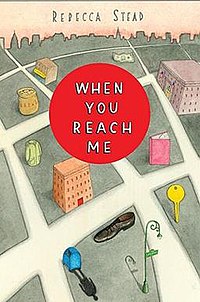
WHEN YOU REACH ME
By: Rebecca Steed


1. Bibliography
Stead, Rebecca. WHEN YOU REACH ME. New York: Wendy Lamb, 2009. Print. ISBN: 9780375850868

2. Plot Summary
WHEN YOU REACH ME by Rebecca Stead is a science fiction story set in 1970s. Miranda is a sixth grade girl who is the receiver of several mystery notes. The writer of these mysterious letters tell her that they are trying to protect her friend. Thoughout this time Miranda is going through various changes including her mother training for $20,000 Pyramid game show and a close friend who will no longer speaks to her. Miranda learns many things along the way including the identity of the mystery writer.

3. Critical Analysis
Stead begins the book by Miranda telling us that she still needs to write the mystery person a letter. Then the story moves to the past tense of Miranda writing the letter to the mystery writer.  Stead makes it difficult to follow along with the time frame of this book.  The plot seems to move to the past, present, future tense and the reader is left feeling they need a calendar to keep up with the dates.

Miranda is faced with many issues that young people are faced with including the lose of friendships and the challenges of making new friends. "Sometimes you never feel meaner than the moment you stop being mean. It's like how turning on a light makes you realize how dark the room had gotten. And the way you usually act, the things you would have normally done, are like these ghosts that everyone can see but pretends not to." Miranda also learns that her biggest enemy, Julia and her have many things in common.

The setting of this book is the Upper West Side of New York City.  Through the details we learn that Miranda lives in an apartment building and walks to school each day.  She also makes frequent stops at a local shop owned by a family friend.

The chapter titles are categories that could be on the $20,000 Pyramid game show.  This is a reminder to the reader that Miranda's mom is training to be on the game show.  Another interesting character in the book is "the laughing man."  We have no idea who this person is and what relation he has to the story until the end of the book.  We learn that "the laughing man" is Marcus who used time travel to save Miranda's friend Sal.


4. Review Excerpts:
~2010 Newbery Award

~SCHOOL LIBRARY JOURNAL 2009 "This unusual, thought-provoking mystery will appeal to several types of readers."

~BOOKLIST 2009 "The ’70s New York setting is an honest reverberation of the era; the mental gymnastics required of readers are invigorating; and the characters, children and adults, are honest bits of humanity no matter in what place or time their souls rest."

5. Connections:
~Students could play the game $20,000 Pyramid
~Students could write about a time they would like to time travel to

Other books by Rebecca Stead:
FIRST LIGHT
LIAR & SPY


Sunday, April 7, 2013

TURTLE IN PARADISE
By: Jennifer L. Holm


1. Bibliography:
Holm, Jennifer L. TURTLE IN PARADISE. New York: Random House, 2010. Print. ISBN: 9780329839017

2. Plot Summary
TURTLE IN PARADISE is a historical fiction novel about a young girl during the Great Depression in 1935. Turtle is forced to move to Key West to live with relatives while her mother takes a job as a housekeeper for a couple that didn't like children. While in Key West, Turtle becomes friends with her cousins who run the "Diaper Gang."  After the children go on a treasure hunt and end up missing for a few days, Turtle learns that family is the most important thing in life.

3. Critical Analysis
The story is set in 1935 during the Great Depression. Many of the families faced various struggles during this time including money. This is true to the time of the Great Depression. The story is told from Turtle' perspective with vivid details of growing up during the Great Depression. Many of the children in the story do not wear shoes and go on wild adventures through town. The author gives enough detail to help the reader understand life during this time period, but does not overwhelmed the reader with great details. "There's a fella selling live flopping fish right on the dock and another one who's unloading some scary-looking cargo: dead sharks." The children are left to wonder the streets on their own each day and even go on a treasure hunt after Turtle finds a map in a piano at her grandmother's house. Children will enjoy reading this story for the dialogue and adventure.

From the author's notes at the end of the book, we learn that TURTLE IN PARADISE is based on family history of Holm's great-grandmother. The author includes pictures of the neighborhood where the book was set, important buildings of the time period, and a picture of Shirley Temple.  Turtle learns that not everyone will have a Shirley Temple ending to their story. Holm includes additional resources that she consulted for historical information as well as websites.

4.  Review Excerpts
~2011 Newbery Honor

~SCHOOL LIBRARY JOURNAL 2010: "This richly detailed novel was inspired by Holm's great-grandmother's stories. Readers who enjoy melodic, humorous tales of the past won't want to miss it."

~HORN BOOK MAGAZINE 2010: "The episodic novel includes details, events,
and figures from history (including those from Holm's own family), and Turtle's narrative is peppered with references from the time, as she compares herself to Little Orphan Annie and gladly avoids going to a Shirley Temple movie. Modern-day readers will have no trouble relating to Turtle, though, and the fast-moving plot will keep them interested to the end."

5. Connections
~Have students bring in old family photos and write their own story of history while including themselves as the main character.

~Have students research more about Key West during the Great Depression using the websites listed in the author's notes.

Other books by Jennifer L. Holm
PENNY FROM HEAVEN
THE CREEK
BABYMOUSE Series


Saturday, April 6, 2013

ONE CRAZY SUMMER
By: Rita Williams-Garcia

1. Bibliography
Williams-Garcia, Rita. ONE CRAZY SUMMER. New York: Amistad, 2010. EAudio. Narrated by Sisi Aisha Johnson ISBN:9781449821968

2. Plot Summary
ONE CRAZY SUMMER by Rita Williams-Garcia is a historical fiction book set in the summer of 1968.  Delphine and her two younger sisters are forced to spend a month during the summer with their mother that they do not know. The girls suddenly realize that their mother is not happy about the arrangements of keeping the girls.  They are forced to spend their days at a summer camp sponsored by the Black Panthers during the Civil Right Movement.  After several triumphs, the sisters form a love for their mother and she returns the love. 

3. Critical Analysis
I listened to the audio book offered through One Click Digital Media. The story is narrated by Sisi Aisha Johnson and produced by Recorded Books, LLC. Johnson does a superb job of narrating distinct voices for each character in the book.  Through her narration, the reader gets a glimpse of the strong Delphine and how she cares for her younger sisters.  Fern's character is young and playful while Vonetta is the sister that desired attention. Johnson's voice for their mother Cecile is cold and unloving. Cecile says "I didn't send for you. Didn't want you in the first place." Other characters in the book have distinct voices as well including the roughness of a boy.

Johnson's narration is clear and portrays the language of the time period.  I feel that the audio book helped me to understand the time period better and made the characters come to life with their distinct voices. The book contains some poetry and Johnson's narration helps the readers to grasp the meaning of the poem through her expression and verbal emotions present.

The story is narrated through the Delphine's point of view. Many racial situations are present in the story that could possible have taken place during the Civil Rights Movement. When the girls visit the center sponsored by the Black Panthers, the reader is exposed to tension among the group.  Williams-Garica includes historical events of the time including the underground circulations of the Black Panthers and the Vietnam War.  The story is set in Oakland, California where only their mother's house has a palm tree in the yard and lives in a green stucco house. ONE CRAZY SUMMER is a story that helps youth to understand that they can make a difference.

4. Review Excerpts:
~ 2011 Coretta Scott King Award

~ 2011 Newbery Honor Book

~2011 Scott O'Deal Award

~SCHOOL LIBRARY JOURNAL: "Seeing the historic summer of '68 through the eyes of sensitive, intuitive Delphine is a treat. Featuring flawless writing and narration, this is storytelling at its finest."

~BOOKLIST: "Civil discontent seen through the eyes of children reveals another side of African American history in this compelling novel."

5. Connections
~This story could be read during Black History Month.

~Students could read this book after researching more about the Civil Rights Movement which will lead to better understanding of the time era of this book. 

Other Books by Rita Williams-Garcia
LIKE SISTERS ON THE HOMEFRONT
CATCHING THE WILD WAIYUUZEE
JUMPED


STORYTELLER
By Patricia Reilly Giff


1. Bibliography
Giff, Patricia Reilly. STORYTELLER. New York: Wendy Lamb, 2010. Print. ISBN:9780375838880

2. Plot Summary
STORYTELLER by Patricia Reilly Giff is a historical fiction novel that has two settings. Elizabeth is a young girl who lives in the 21st century. She is sent to live with an aunt she doesn't know. While there, she finds solace in a drawing of her ancestor Zee.  Zee grew up during the Revolutionary War. The story alternates between the lives of these two girls. Elizabeth learns that her and Zee had a lot in common including looks and the gift of storytelling.

3. Critical Analysis
Zee's life is told from the perspective of a young girl during Revolutionary War which Giff includes various details to make this time period come to life for the reader.  The reader is not overwhelmed with details.  Giff gives enough information to make the scene come to life for the reader. The reader learns more about the Revolutionary War and how neighbors were either together or against one another. In Elizabeth's story, we learn the importance of family heirlooms and especially the history of our ancestors.

When Zee went off to war to find her father and brother, we are taken to the front lines of the war. "Everything was color: the orange of the sun, the shiny green of the washed leaves, the red of the blood everywhere." The reader is given a look at the front lines of the war and the images that Zee must have seen.

The speech for the time of the Revolutionary War is not portrayed in this story.  Through Zee's story, the speech is more of the modern day like Elizabeth's.  Elizabeth and Zee face some of the same struggles even though they are 100's of years apart. Giff does a wonderful job of intertwining the lives of these two girls. Through the author's note at the end, the reader learns the factual basis behind this story.

4. Review Experts
KIRKUS REVIEWS 2010: "Still, this is a lovely story about love and loss, a little-known aspect of Revolutionary history and the way the past informs the present, and the ending is gratifying." 

SCHOOL LIBRARY JOURNAL 2010: "The fast-paced narrative, toggling back and forth between the 18th and 21st centuries, will keep readers interested. 

5. Connections
~Students could research different elements of the Revolutionary War in groups and present their findings to classmates.  This would help to build background knowledge of the War before students read this historical fiction novel. 

~Students could ask their parents about their family history and create their own journal to pass down to family members.          

Other book by Patricia Reilly Giff:
ALL THE WAY HOME
LILY'S CROSSING
MAGGIE'S DOOR


Friday, March 22, 2013

WALT WHITMAN: WORDS FOR AMERICA
By: Barbara Kerley, Illustrated by Brian Selznick


1. Bibliography
Kerley, Barbara, and Brian Selznick. WALT WHITMAN: WORDS FOR AMERICA. New York: Scholastic, 2004. Print. ISBN: 0439357918

2. Plot Summary
WALT WHITMAN: WORDS FOR AMERICA is a picture book biography of Walt Whitman's life. Walt Whitman was a journalist who began working as an printer's apprentice at twelve years old. He eventually became a well known American poet.  Walt's younger brother went off to fight in the Civil War.  Walt received word that his brother had been hurt, so Walt went looking for him.  While Walt was there he became a volunteer nurse for the Civil War, which helped to inspire his poetry.

3. Critical Analysis
The author included many details of Walt Whitman's life. The reader learns that Walt was concerned about mankind and his poems were wrote to reflect this.  "Black, white, Union, Confederate - Walt nursed whomever he saw. He fed men too weak to eat." The illustrations complement the text by showing that Walt had respect for soldiers and caring for those unknown to him. The author's style is interesting while including many quotes from Walt's poems.  At the back of the book, the author includes many poems written by Walt. The author also includes a section of notes at the end of the book along with sources used for this book.

The illustrations included in this book help to tell the story of Walt's life.  Most of the pictures are two spread with little white space except for the text.  The illustrator included pictures with rich colors and attention to detail.  From the illustrators note in the back, we learn that a lot of research was put into the illustrations. The page opposite the title page is illustrated to resemble a typeset page imposition of the title page.

4. Review Excerpts
~Robert F. Sibert Honor Book

~HORN BOOK MAGAZINE 2004 "Whitman lovers everywhere should give joyful thanks for this splendid presentation."

~SCHOOL LIBRARY JOURNAL 2005 "Attractive colored-pencil drawings capture the careful research done on this picture-book biography for older readers."

5. Connections
~This biography could be read to students as an introduction to the Civil War.

~While reading this book about Walt Whitman, students could be given a map to pin point the places that he visited and lived for a lesson on geography.

Other books by Barbara Kerley:
THE EXTRAORDINARY MARK TWAIN
ONE DAY, ONE WORLD
WHAT TO DO ABOUT ALICE?


Wednesday, March 20, 2013

BIG BUGS
By: Seymour Simon

1. Bibliography
Simon, Seymour. BIG BUGS. San Francisco, CA: SeaStar, 2005. Print. ISBN: 1587172534

2. Plot Summary
BIG BUGS is a non-fiction book for young children that includes bugs from different parts of the world. These bugs included the giant water bug, a bulldog ant, and a bird-eating spider. With large close up pictures, children will enjoy learning more about these animals.

3. Critical Analysis
Seymour Simon helps the readers to see the big bugs up close that are discussed in his book, BIG BUGS. The book includes some interesting facts about a goliath beetle who can break glass windows and a bird-eating spider that does actually eat birds.  The book contains some interesting facts, but several elements are missing.  The author does not include any source notes, bibliographies, or an extended reading list.  Even though this book is written for younger children, these non-fiction resources should have been included.  These children may want to learn more about these bugs, and Simon has missed the opportunity to extend their learning further.

The author's style is engaging, thanks to the pictures and simple sentences.  The book contains enough factual information to keep the reader interested without over boring them. Some of the interesting information included is that "When a mantis catches an insect, it feeds on it like a person eating an ear of corn."  The author's information helps the readers to relate to the bugs using their background knowledge. The text is easy to read because of the large print and a text box.

The pictures are large and shows great detail about each bug.  The pictures complement the text.  Most pages include a small box showing the actual size of the bug. The pictures help the reader to see details about each bug, including close up pictures of bugs you would not like to see close up.

4. Review Excepts
BOOKLIST 2005: "One excellent graphic feature, often used here when the photo has be enlarged, is an inserted box showing the actual size of the animal with its body position identical to that shown in the main picture. Some of the photos are eye-catching and dramatic."

SCHOOL LIBRARY JOURNAL 2005: "The information is better organized and offers limited but solid introductions to the giant water bug, the goliath beetle, and robberflies."

5. Connections:
~This book could be used to introduce younger students to the benefits of non-fiction books.
~After reading this book, have children find a partner and research more information about a bug listed in this book.

Other books by Seymour Simon
BUTTERFLIES
DEADLY ANTS
WILD BABIES